
By Kenny Lau
In this era of technological advancement, we tend to seek the newest and latest – they seem to automatically guarantee high performance, consistency and longevity. However, modern methods often entail unsustainable levels of energy consumption and the over-exploitation of resources, to the detriment of our environment. What if all of this was unnecessary?
Sometimes, the answer lies within the wisdom of our ancestors. Nearly three thousand years ago, the Chinese developed a complicatedly simple system of support that revolutionised Eastern construction – the Dougong. The technique became adapted by Japanese buddhist monks and was passed onto Miyadaiku craftsmen, who refined the art into the Tokyō. Consisting of only wooden beams, brackets and eaves, this method of construction does not require glue, binding agent, or nails. Aesthetically, the mahogany hues of these wooden structures, combined with their intricate curvy and protruding forms, juxtapose with the cool concrete of city architecture and create an other-worldly, majestic yet inviting effect. Functionally, it is essential in distributing the weight of the heavy, slanted tiled roofs; the more layers of brackets and eaves, the more load it can support.

Perhaps why these shrines and temples even exist today is thanks to the most critical property of the Tokyō system – earthquake resilience. It is hard to imagine that these shrines and temples, which are built upon elevated platforms and don’t even have any form of underground foundations, have prevailed hundreds of earthquakes reaching magnitudes of over 7 and still stand strong. An earthquake simulation testing the strength of Dougong/Tokyō systems even demonstrates that they can survive a magnitude of 10.1(https://youtu.be/w78Yb_aotH0). The reason behind this is the elasticity and flexibility provided by the interlocking joints. By securing them in a relatively loose manner, the joints act as shock absorbers, allowing the oscillation of the roof to counteract the oscillation of the ground, thus preventing the structure from collapse.

The art of interlocking wood carpentry, known as Kigumi, has also been applied in modern contexts by architects and designers who wish to exemplify that innovation does not have to break away from tradition. The work of Kengo Kuma, a Japanese architect, are fine examples of this principle. Kigumi is widely made use of in Kuma’s Yusuhara Wooden Bridge Museum and Prostho Museum Research Centre, where he plays with scale and minimalism. By using materials that relate to the local environment, Kuma suggests a sense of fragility and immateriality through his work.
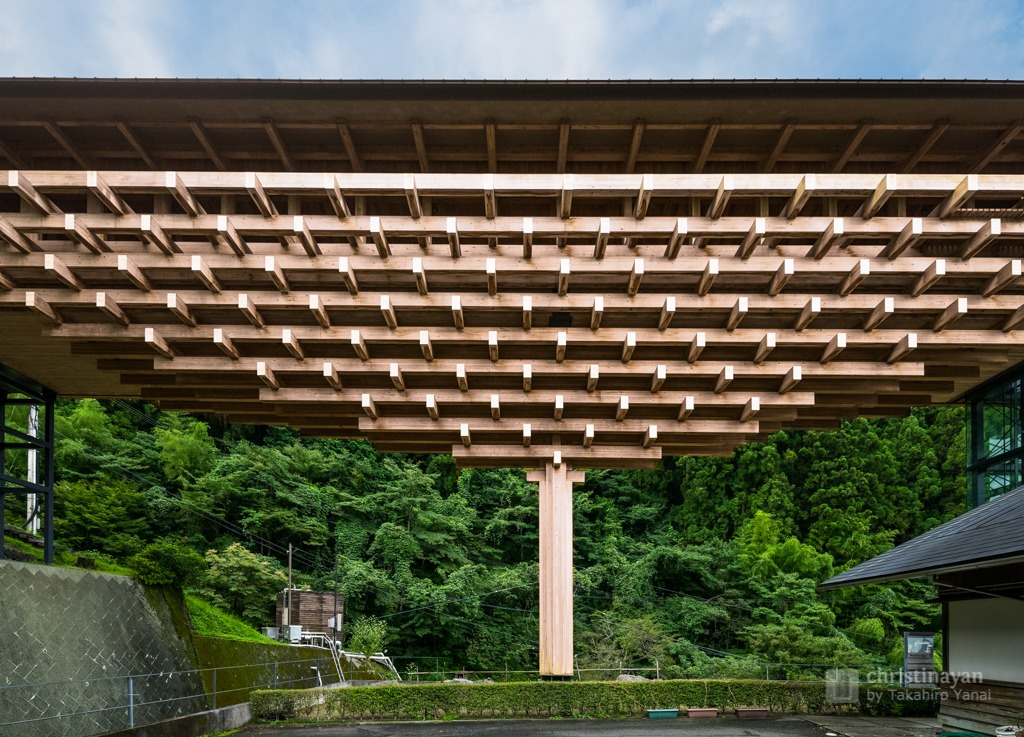
Problems of the present do not always require cutting edge solutions; instead, we should learn to look into our past and our surroundings in search of humble resolutions. Check out our other articles if you like this!
 HOME | Archive